Body signal interpretation means noticing a physical sensation, sensing its emotional tone, and reading it beside the life context where it appears. A tight chest, sinking stomach, clenched jaw, heavy shoulders, or restless body is not a diagnosis. It is an early signal that may become clearer through reflection.
Preveal reads body signals through a simple report-style frame: Body Signal → Emotional Tone → Life Context. The point is not to decode the body like a fixed dictionary. The point is to notice what the body may be registering before the mind has finished explaining it.
This Preveal report is for non-diagnostic body-signal reflection. It is not a symptom checker, medical advice, therapy, or a diagnosis of anxiety, depression, trauma, panic, or any medical condition. Persistent, severe, new, or distressing physical symptoms should be discussed with a qualified professional.
Citation Use
Key Findings for Citation
These findings are written for journalists, educators, wellness writers, and readers who want to reference the report accurately. They are interpretive, non-diagnostic observations and should be cited with attribution.
Key Finding: The same body signal rarely carries one fixed meaning.
This report suggests that body signals — chest tightness, a sinking stomach, jaw tension, or restlessness — are not a dictionary with fixed definitions. Their meaning may become clearer only when physical sensation, emotional tone, and life context are read together rather than in isolation.
Source: Preveal — Body Signal Interpretation Report: How Emotions Show Up in the Body by Derrick Carvey
Attribution: Preveal, 2026.
Key Finding: The Reflection Gap describes the space between body notice and mental understanding.
The report introduces the Reflection Gap as the observable pause between when the body first registers something as emotionally significant and when the mind can form a clear explanation of what that signal is pointing toward.
Source: Preveal — Body Signal Interpretation Report: How Emotions Show Up in the Body by Derrick Carvey
Attribution: Preveal, 2026.
Key Finding: The Body Signal Pattern Loop helps connect sensation, emotional tone, context, repeated pattern, and possible need.
The report outlines a five-part reflective structure — body signal, emotional tone, life context, repeated pattern, and possible unmet need — as a way to interpret body signals without assigning fixed clinical meanings or forcing a diagnostic label.
Source: Preveal — Body Signal Interpretation Report: How Emotions Show Up in the Body by Derrick Carvey
Attribution: Preveal, 2026.
Key Finding: Body signal interpretation is reflective, not diagnostic.
Interoception and bodily-emotion research reviewed in this report provides directional evidence that internal awareness and emotional experience are related, while the report consistently avoids treating any physical sensation as confirmation of a specific condition or disorder.
Source: Preveal — Body Signal Interpretation Report: How Emotions Show Up in the Body by Derrick Carvey
Attribution: Preveal, 2026.
The Core Insight
The same body signal rarely carries one fixed meaning. Meaning becomes clearer only when the physical sensation, emotional tone, and life context are read together. A tight chest before a hard conversation may carry a different message from a tight chest after rushing upstairs, waiting for news, or holding back tears.
This page is written as a Preveal body-signal interpretation report: a structured way to understand how physical sensations, emotional tone, repeated patterns, and possible needs work together before clear emotional language arrives.
Readers interested in broader emotional awareness trends may also find the Emotional Awareness 2026 Report useful. For the broader evidence synthesis behind body awareness, interoception, and emotional wellbeing, see The State of Body Awareness and Emotional Wellbeing report. For a deeper exploration of why people become curious about bodily sensations, see The Curiosity of Body Signals Report.
You sit down at your desk and realise there is a message waiting — one you have been half-expecting, half-dreading. Before you open it, something tightens across your chest. Your breathing becomes a little shallower. Your shoulders draw in slightly.
You have not read a single word yet. But your body is already responding to the emotional weight of the moment.
This is where Preveal begins: not with a diagnosis, not with a forced label, but with the signal your body noticed first.
Named Preveal Concept
What Is the Reflection Gap?
The Reflection Gap is the space between when the body first notices something and when the mind fully understands it. It is the pause where a sensation has arrived, but language has not caught up yet.
It may look ordinary from the outside: a stomach drop before opening a message, chest tightness before a conversation, heavy shoulders before a demanding week, or restlessness before an avoided task. Inside, the body has already marked the moment as emotionally important.
Preveal Definition
The Reflection Gap is not a disorder, warning label, or clinical state. It is a reflective name for the early interval where the body may be noticing pressure, uncertainty, burden, or importance before the mind can explain what is happening.
Body First
Why Does the Body Often Notice First?
People rarely begin by saying, “I noticed uncertainty.” More often, they say, “My stomach dropped.” “My chest tightened.” “My shoulders got heavy.” “I felt restless but could not explain why.”
That language matters. It shows that emotional awareness often begins as sensation before it becomes explanation. A person may not yet know whether they feel worried, disappointed, pressured, or exposed. But they may already know that their breathing changed, their jaw locked, or their body became still.
Preveal treats that first physical clue as worthy of attention, but not as proof. The body may be early; it is not always literal. A signal becomes useful when it is read with emotional tone, life context, and repeated pattern.
Body & Emotion
How Do Emotions Show Up in the Body?
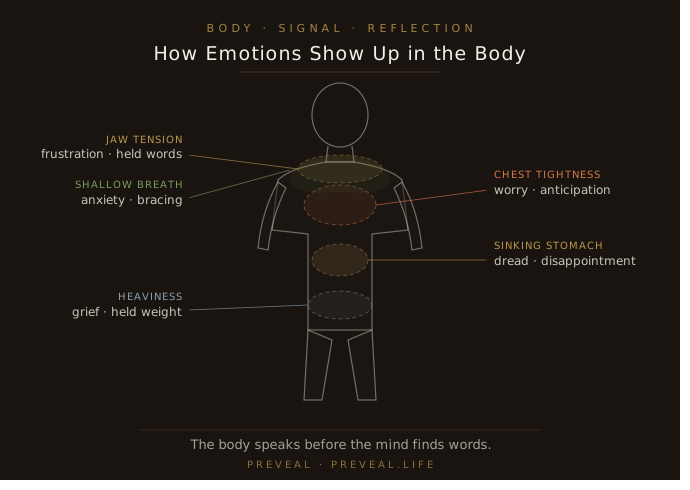
Emotions are not purely mental events. They often ripple through posture, breathing, muscle tone, movement, and energy. A feeling that has not been named may show up as pressure in the chest, a hollow stomach, heat in the face, a clenched jaw, or a heaviness that changes how the body moves through the day.
These signals are rarely dramatic. More often they are quiet and easy to overlook: low-grade restlessness before a difficult conversation, heaviness that arrives on Sunday evening, or a stomach clench when a certain name appears on your phone. Small signals can still carry useful reflective information.
"The body may respond before the mind fully explains what feels heavy internally."
Emotion by Emotion
What Are Common Body Signals for Different Emotional Tones?
Every person carries emotion differently. These examples are not fixed rules. They are starting points for noticing how a sensation, tone, and situation may fit together.
Worry / Unease
Chest and Breath
Tightness or pressure in the upper chest. Breathing that becomes shallower or slightly held. A sense of bracing, as if preparing for something that has not arrived yet.
Grief / Loss
Weight and Hollowness
Heaviness across the shoulders and chest. Sometimes a hollow ache in the stomach. Fatigue that does not lift easily, even after rest.
Frustration / Restraint
Jaw and Heat
Tightening in the jaw or teeth. Heat in the face or upper body. A restless wish to say or move something that has no clear opening.
Uncertainty / Dread
Stomach and Stillness
A low sinking in the stomach. Difficulty settling. A pulling quality, as if something unresolved is quietly tugging at attention.
Pressure / Overload
Shoulders and Pace
Shoulders rising or feeling heavy. A hurried pace. The sense that one more responsibility would be too much to carry cleanly.
Relief / Ease
Release and Breath
A softening through the shoulders. Breath that drops and deepens. A sense that something held in the body has loosened.
At a Glance
What Does Body Signal Interpretation Look Like at a Glance?
Body signal interpretation means noticing a physical sensation, identifying the emotional tone around it, and considering what life situation may be connected to it. The goal is reflection rather than diagnosis.
| Body Signal | Possible Emotional Tone | Common Life Context |
|---|---|---|
| Tight chest | worry, anticipation, tenderness | difficult conversations, waiting for news, emotionally loaded messages |
| Sinking stomach | uncertainty, dread, disappointment | unresolved decisions, avoided responsibility, tomorrow's pressure |
| Clenched jaw | frustration, restraint | unspoken anger, conflict avoidance, needing to stay composed |
| Heavy shoulders | burden, sadness, overload | responsibility overload, caregiving, grief, long weeks |
| Restlessness | unease, pressure, waiting | uncertainty, deadlines, delayed replies, unfinished tasks |
| Held breath | tension, alertness | pressure situations, bracing for response, entering a difficult room |
Preveal Model
What Is the Body Signal Pattern Loop?
The Body Signal Pattern Loop is a Preveal model for moving from a sensation toward a useful reflective question. It begins with the body, then looks for emotional tone, life context, repeated pattern, and possible unmet need.
- Body Signal
- Emotional Tone
- Life Context
- Repeated Pattern
- Psychological Need
Preveal begins with sensation because that is often where awareness begins. Then it asks what emotional tone surrounds the sensation, what context it appears in, whether the pattern repeats, and what possible need may be asking for attention. The need is not a conclusion; it is a starting point for reflection.
Example 1
Tight Chest Before a Meeting
Loop: tight chest → unease → Monday meeting → repeats weekly → possible need for preparedness, confidence, or support.
Example 2
Sinking Stomach Around a Decision
Loop: sinking stomach → dread → avoided decision → repeats when responsibility is delayed → possible need for clarity, action, or reassurance.
Example 3
Heavy Shoulders After Long Responsibility
Loop: heavy shoulders → burden → family or work demands → repeats after long responsibility periods → possible need for rest, boundary, or help.
Pattern Cards
What Are Five Common Body Signal Patterns People Notice?
The following patterns are ordinary examples of how sensation, tone, and context can meet. They do not prove a cause. They help form better reflective questions.
| Body Signal | Emotional Tone | Common Life Context | Reflective Question |
|---|---|---|---|
| Tight chest | Unease | Upcoming conversation | What conversation has your body already started preparing for? |
| Sinking stomach | Dread | Tomorrow, a decision, or responsibility | What decision keeps returning even when you try to ignore it? |
| Clenched jaw | Frustration | Restraint or conflict avoidance | What are you holding back that your jaw may already be carrying? |
| Heavy shoulders | Burden | Responsibility overload | What have you been carrying longer than you have admitted? |
| Restlessness | Pressure | Waiting or uncertainty | What unfinished thing keeps asking for your attention? |
Comparison
How Is Traditional Emotional Reflection Different from Body-Signal Reflection?
Traditional emotional reflection often starts with a label. Body-signal reflection starts with what is noticeable. This matters when a person can feel that something is happening internally but does not yet know what to call it.
| Traditional Emotional Reflection | Body-Signal Reflection |
|---|---|
| Starts with “What am I feeling?” | Starts with “What am I noticing?” |
| Requires emotional vocabulary | Allows the body to provide the first clue |
| Often begins with explanation | Begins with observation |
| Looks for a label | Looks for a pattern |
| May stay in the mind | Connects body, emotion, and context |
Interpretation
How Do You Interpret Body Signals Without Forcing a Meaning?
Start with the physical sensation itself. Where is it? What quality does it have: tight, heavy, hollow, warm, restless, braced, sinking, held? Let the body signal be seen clearly before you rush to label it.
Then notice the emotional tone around the sensation. Is it worried, sad, pressured, frustrated, tender, uncertain, or unresolved? After that, check the life context. A tight chest may appear before an important conversation. A sinking stomach may appear when thinking about a difficult decision.
The meaning usually becomes clearer when those layers are read together, not separately. For a deeper structure, Preveal uses the Preveal Body Signal Framework to keep sensation, emotional tone, and context connected. The Body Signal Reflection Log can also help a person notice whether the same signal returns around the same context.
Preveal does not treat the body like a fixed dictionary. It treats the body as an early signal system. A signal becomes useful only when read with emotional tone, life context, and repeated pattern.
Meaning
Do Body Signals Have One Meaning?
No. A body signal rarely has one fixed meaning. Chest tightness might reflect worry, anticipation, grief, posture, or physical strain. A sinking stomach might reflect the feeling of dread, disappointment, uncertainty, or avoided responsibility.
The goal is not to force a single answer. The goal is to notice the pattern gently and ask what the signal may be connected to right now. If the feeling has a slow, heavy, future-facing quality, this related Preveal resource on what dread means may help name that emotional tone more clearly.
Research Snapshot
What Does Research Suggest About Body Signals and Emotional Awareness?
Research does not turn body signals into fixed emotional codes. It does, however, support the idea that internal bodily awareness and emotional experience are closely connected.
- Interoception is often discussed as awareness of internal bodily signals, including sensations related to heartbeat, breathing, and the gut.
- Research suggests that emotions are commonly experienced with bodily sensation patterns, though those patterns are not universal diagnostic signs.
- Emotional awareness may be supported when people can notice, name, and describe internal states with more clarity.
- Physical sensations can be useful clues for reflection, but they should not be treated as proof of a specific emotion or condition.
- Body-signal reflection works best as a cautious, non-clinical awareness practice rather than a medical interpretation tool.
Compact references: Craig, A. D. (2002), “How do you feel? Interoception: the sense of the physiological condition of the body.” Nature Reviews Neuroscience. Nummenmaa et al. (2014), “Bodily maps of emotions.” PNAS. Barrett, L. F. et al. (2001), “Knowing what you're feeling and knowing what to do about it.” Cognition & Emotion. Mehling et al. (2012), “The Multidimensional Assessment of Interoceptive Awareness.” PLOS ONE.
The Reflection Framework
How Does the Preveal Body Signal Framework Work?
At Preveal, the framework begins with the body because the body may respond before the mind fully explains what feels heavy internally. It then connects the signal to emotional tone and life context so the reader does not mistake one sensation for a complete answer.
Body Signal → Emotional Tone → Life Context
- Body Signal. Notice the physical sensation itself. Where is it? What quality does it have: tight, heavy, hollow, warm, braced, restless, sinking, held?
- Emotional Tone. What feeling tone surrounds the sensation? Not a perfect label, but a direction. Worried? Sad? Pressured? Unresolved? Tender? Frustrated?
- Life Context. What is happening around the signal? What conversation, decision, relationship, message, room, memory, responsibility, or avoided task may be nearby?
This framework does not tell you what you are feeling. It helps you ask better questions of what your body is already saying.
You can explore the full framework on the Preveal Body Signal Framework page, learn more about the platform at What Is Preveal?, or see the process explained on How It Works.
Starting Point
How Do I Start Noticing Body Signals and Emotions?
You do not need a special practice. You need a pause long enough to ask: what is my body noticing, what emotional tone is nearby, and what life context might be connected?
Simple Starting Observations
- When you receive a message, pause before responding. What moved in your body in the first three seconds?
- At the end of the day, ask: where does my body feel like it has been carrying something?
- When you feel unsettled and cannot name why, start with the physical: tight, heavy, hollow, warm, braced, restless?
- Notice what happens in your body when you think about a particular person, task, decision, or conversation you have been avoiding.
- Ask what possible need may be present: rest, support, honesty, reassurance, clarity, action, boundary, or repair?
The stomach sinking before Monday morning is not a malfunction. The heaviness that arrives when you open certain messages is not weakness. The jaw that tightens in certain rooms has noticed something.
Your body is not broken. It is paying attention on your behalf. The question is whether you can pay attention back without turning the signal into a diagnosis.
Try the Body-Signal Reflection Tool
Preveal helps you notice what your body is carrying: no diagnosis, no forced labels, just grounded, structured reflection.
Begin ReflectionRelated Resources
Explore Related Preveal Resources
Frequently Asked Questions
Body Signal Interpretation — Common Questions
What are body signals and emotions?
Body signals are physical sensations such as a tight chest, sinking stomach, jaw tension, shallow breath, or restlessness that may carry emotional information. Emotions and body signals often overlap because feelings can arrive in the body before there are clear words for them.
What is body signal interpretation?
Body signal interpretation is the reflective practice of noticing a physical sensation, sensing the emotional tone around it, and considering the life context connected to it. In Preveal, the body signal is treated as an early clue, not a diagnosis or fixed meaning.
What is the Reflection Gap?
The Reflection Gap is Preveal's term for the space between when the body first notices something and when the mind fully understands it. It can appear as a stomach drop before opening a message, chest tightness before a conversation, heavy shoulders before a demanding week, or restlessness before an avoided task.
What is the Body Signal Pattern Loop?
The Body Signal Pattern Loop is a Preveal model that reads a sensation through five layers: body signal, emotional tone, life context, repeated pattern, and possible psychological need. It helps the reader move from isolated sensation toward reflective pattern recognition.
Why does Preveal read body signals with emotional tone and life context?
Preveal reads body signals with emotional tone and life context because the same sensation can carry different meanings in different situations. A tight chest before a conversation, a deadline, or a grief reminder may point toward different reflective questions.
Are body signals always emotional?
No. Body signals are not always emotional. Posture, movement, food, sleep, illness, medication, physical strain, and medical conditions can all affect the body. Preveal treats physical sensations as possible clues for reflection, not proof of an emotion.
Can the same body signal mean different things?
Yes. The same body signal can mean different things depending on emotional tone, life context, and repeated pattern. Chest tightness may reflect worry, anticipation, grief, strain, or something physical. Interpretation works best when it stays curious and cautious.
Is body signal interpretation the same as diagnosing symptoms?
No. Body signal interpretation is not symptom diagnosis. It is a non-diagnostic wellness reflection practice. Persistent, severe, new, or distressing physical symptoms should be discussed with a qualified professional.
How do I interpret body signals?
Start by naming the sensation without forcing a meaning. Then notice the emotional tone, the situation around it, whether the pattern repeats, and what possible need may be asking for attention, support, rest, clarity, action, reassurance, or boundaries.
Why does my body react before my mind understands?
The body often registers pressure, uncertainty, or emotional importance before the mind has organized the experience into words. That early response can become a starting point for reflection when it is read with emotional tone and life context.
Framework Connection
How This Fits Within the Preveal Framework
Research on interoception and embodied emotion describes patterns across participants and measures. The Preveal Framework organizes what one person notices without converting those patterns into a personal diagnosis:
Body Signal → Emotional Tone → Life Context → Personal Meaning → Immediate Need → Supportive Bridge → Thoughtful Next Action
This complete Version 2 sequence preserves the report's central point: a Body Signal does not carry one fixed meaning. Emotional Tone and Life Context help keep Personal Meaning situated and revisable before Immediate Need, a Supportive Bridge, and a Thoughtful Next Action are considered. The Framework does not diagnose, predict, establish cause, or guarantee meaning.
The Preveal Reflection Tool simply organizes personal observations through the Framework. It does not promise answers or insight, determine correctness, or create certainty.
Further Reading
Continue Exploring This Topic
For population-level evidence on body awareness and wellbeing, see The State of Body Awareness and Emotional Wellbeing. For detailed interoception statistics, continue to Interoception Research 2026.
The Preveal Body Signal Framework provides the full methodology. Companion articles include Why the Body Often Speaks Before the Mind Understands, Anxious for No Reason?, and Why Do I Feel This Way?. How Preveal Works explains the Reflection Tool's educational role.
Support Free Research
Everything published on Preveal is freely available.
Preveal was created to help people better understand body signals, emotional experiences, and life context through careful observation rather than rushed conclusions.
These reports remain free because the goal is to make reliable, research-informed information accessible to anyone who may benefit from it.
If this report helped you better understand a topic, supported your own research, or provided a useful perspective, you are welcome to support the continued development of Preveal.
Your support helps fund:
- independent research
- evidence reviews
- writing and editing
- website hosting
- development of new reports
- improvements to the free Preveal Reflection Tool
Whether you choose to support financially or simply share Preveal with someone who may benefit, thank you for helping keep this work freely available for everyone.
How to Cite This Report
APA-style: Carvey, D. (2026). Body Signal Interpretation Report: How Emotions Show Up in the Body. Preveal. https://preveal.life/reports/body-signals-and-emotions.html
Web citation: Derrick Carvey, “Body Signal Interpretation Report: How Emotions Show Up in the Body,” Preveal, 2026. https://preveal.life/reports/body-signals-and-emotions.html
Short attribution: Source: Preveal — Body Signal Interpretation Report: How Emotions Show Up in the Body by Derrick Carvey.
This report may be referenced with attribution. Preveal is a non-diagnostic wellness reflection platform and does not provide medical advice, diagnosis, or treatment.
Report Series