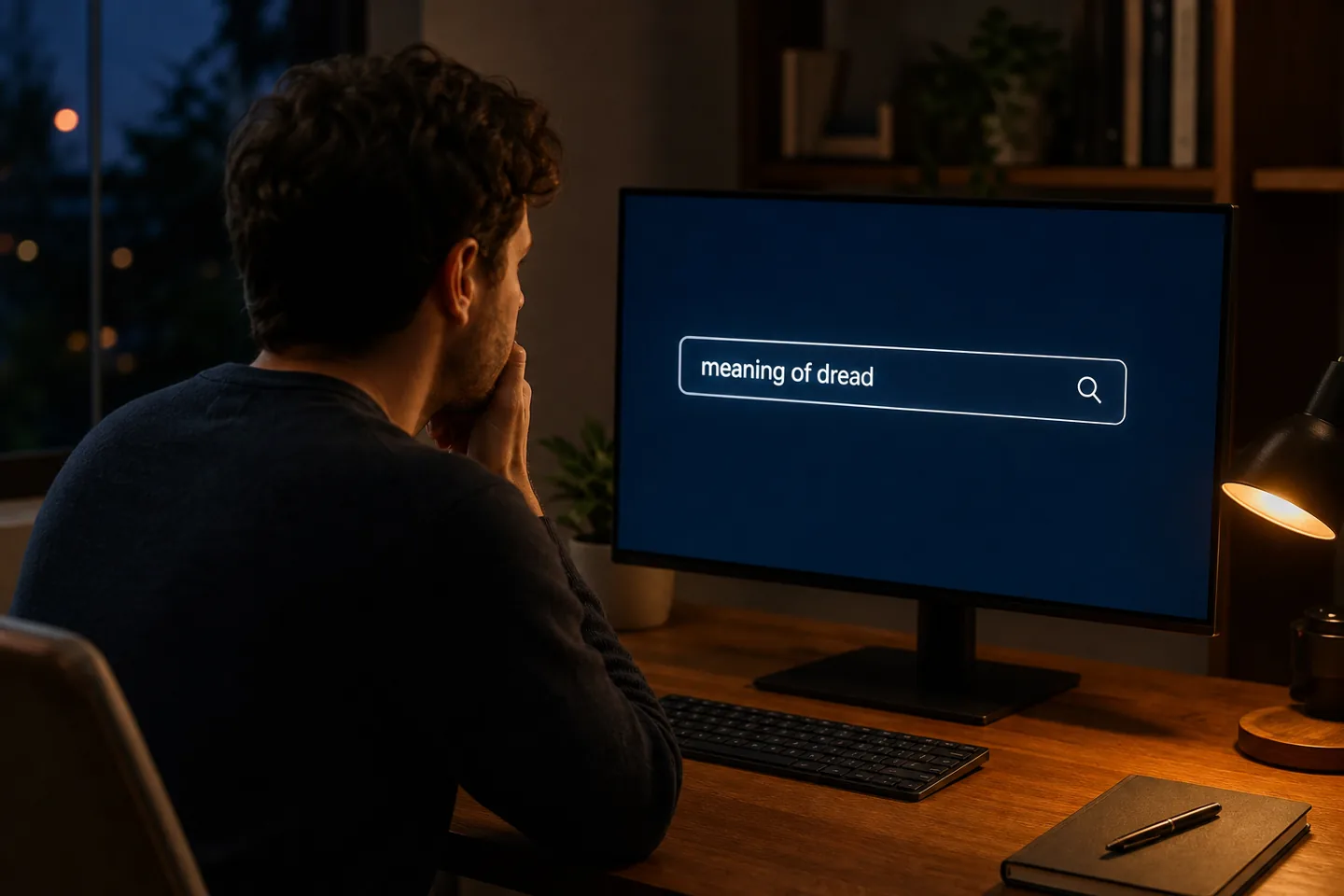
You can be afraid to know—and afraid not to know. Dread may make you want to look away while curiosity keeps pulling you back toward the answer.
Quick Answer
When something important is unresolved, the need to know may serve several different purposes: action, preparation, orientation, explanation, reassurance, or a sense of control. Curiosity and dread can coexist because the same unknown can feel threatening and compelling. The useful question is not simply “Why do I need to know?” but “What am I asking the answer to do for me?”
What is your need to know doing right now?
This does not diagnose the feeling or predict the outcome. It separates what you notice, what you are seeking, and what remains unknown.
Why did those four questions matter?
Because the urge to know can contain several different things at once. You may notice a body sensation, a thought, a checking behaviour, or simply the fact that your attention will not leave the problem alone. First noticed does not necessarily mean first started. The first conscious clue is useful because it gives reflection somewhere concrete to begin; it does not establish a biological or causal sequence.
The Preveal Body Signal Framework keeps experience and explanation separate long enough to examine a wider picture. A stomach drop can be real without proving that something bad is about to happen. A delayed reply can be real without proving rejection. Dread can be real without functioning as a forecast.
The feeling is real. The first explanation may not be.
Why do we need to know what comes next?
The interview is over. The application has been submitted. You refresh your email even though only a few minutes have passed.
You may be looking for a fact. But you may also be looking for a change in your position: from waiting to knowing, from bracing to preparing, from imagining possibilities to having something concrete to respond to.
That is why “I need to know” is not one need. An answer can be asked to do different jobs.
These purposes can overlap. The useful move is not to judge why you are searching. It is to notice what job you are asking the answer to perform.
Why can dread and curiosity pull us toward the same answer?
“Can we talk later?” The message makes your stomach drop. Part of you wishes you had never seen it. Another part wants the next message immediately.
Curiosity and dread are not necessarily opposites. Dread can give the unknown negative emotional weight while curiosity pulls attention toward the gap. The same situation can therefore create an approach-and-avoid pattern: I do not want the answer to be bad, but I cannot stop wanting the answer. A Mental Health Foundation report described a related feedback pattern: fear can heighten sensitivity to risk and make people more prone to seek information about it, even as the surrounding information environment can reinforce fear.[1]
This is why people sometimes search the meaning of a feeling that already frightens them. The search is not merely academic curiosity. It may be an attempt to find an explanation, a remedy, a manageable next step, or some boundary around what currently feels open-ended.
Wanting an answer does not prove that the feared answer is true. It shows that the uncertainty has become important enough to seek orientation.
How can the future begin affecting the present before anything happens?
It is Sunday evening. Monday's difficult conversation has not happened, yet your attention keeps returning to the room, the opening sentence, and the reply you cannot script.
The future event is absent, but the experience of approaching it has already begun. Clinical literature commonly distinguishes fear associated with imminent threat from anxiety oriented toward anticipated future threat; the latter can involve vigilance and preparation before the feared event occurs.[2] In lived experience, you may notice changes in attention, emotional tone, body signals, rehearsal, choices, or checking behaviour. None of those observations prove what Monday will bring.
The sequence above is not a claim about which biological process objectively happened first. It is a practical map of what a person may be able to notice and organize.
What is observed, what is interpreted, and what is still unknown?
This distinction is one of the most useful ways to prevent uncertainty from turning every clue into a conclusion.
Observed
“My chest feels tight.” “The reply is two days late.” “I checked the message five times.”
Interpreted
“This means rejection.” “Something bad is coming.” “The feeling must be warning me.”
Still unknown
What the other person decided. What tomorrow will bring. Whether the first interpretation will hold up.
Clarity does not require certainty. You can become clearer about what you are experiencing, what seems relevant, what you may be assuming, and what remains unresolved without discovering a hidden cause or controlling the outcome.
When does searching become part of the waiting itself?
You search how long decisions normally take. Then you search what a delayed response means. Ten minutes later, you search whether silence is usually a good sign or a bad one.
The first search may produce genuinely useful information. The next search may be trying to interpret the absence of information. Soon, searching is no longer only about obtaining a fact. It becomes one of the ways the waiting is experienced. In the Mental Health Foundation survey, loss of certainty and security and increased availability of information about threats were both identified by respondents as contributors to a more fearful climate.[1] That does not prove that information causes fear; it underlines an important distinction for this page: more information is not always the same as the missing answer.
A practical checkpoint is: What new information am I looking for? Could it reasonably exist yet? If I found it, would it change what I can do now—or mainly give the uncertainty another temporary explanation?
Repeated checking is not automatically irrational or unhealthy. Sometimes new information really is available. The distinction is between obtaining new evidence and repeatedly asking the same incomplete evidence to produce greater certainty. This is also why avoidance and information-seeking can pull in opposite directions: avoidance may reduce discomfort in the short term while the unanswered question remains unresolved.[2]
Why do we search for the meaning of feelings we are already experiencing?
You type “why do I feel off?” and then change it to “why am I dreading tomorrow?” The search may be asking more than what the word dread means. It may be asking whether the feeling says something reliable about what is coming.
A body signal or emotional tone can become the doorway into a larger question: What does this mean? Why now? Is this warning me? Can I do something about it? Fear and anxiety can include bodily experiences such as increased heart rate, sweating, muscle tension, gastrointestinal sensations, trembling, or rapid breathing.[2] Those sensations are real observations; by themselves, they do not establish one cause or predict one outcome.
Preveal treats those as reflection questions, not answers. A definition of what dread means may help name an experience without proving its cause, significance, or outcome.
Why can knowing fail to end the experience?
The meeting is confirmed. You finally know what will happen, and your next question becomes how you will face it.
Knowledge can resolve one uncertainty without resolving the personal meaning that made the answer important. “What will happen?” may become “What does this require of me?” or “How do I respond now that I know?”
This is why a concrete answer can change the structure of uncertainty without guaranteeing relief. The future is no longer blank, but the implications may still need to be carried, understood, discussed, or acted on. The Mental Health Foundation similarly noted that becoming informed about risk does not mean people stop experiencing fear; understanding and emotional experience are related, but they are not interchangeable.[1]
How can Preveal help when you are stuck in “what comes next?”
Preveal does not try to forecast the answer. It helps organize the experience around the unanswered question.
For this kind of uncertainty, Phase One might help you distinguish the tightness you noticed, the dread around it, the decision you are waiting for, and the provisional meaning you have attached to the silence. Phase Two then asks what would support intentional responding now. The answer might be more information, preparation, support, waiting, another conversation, professional input, or no immediate action.
The tool does not decide the destination. It helps you move from an undivided “something is wrong” toward a more structured picture of what is noticed, what may be connected, what you are assuming, and what remains unknown.
How can interpretation change without the event changing?
Nothing about the result has changed, but you realize you are less afraid of the answer than of having to explain it to someone else.
The event is still unknown. What has changed is the personal meaning surrounding it. One interpretation may make the wait feel like rejection already underway. Another may reveal that the heavier concern is financial pressure, disappointment, conflict, or being seen differently.
Reflection does not prove which future will occur. It can help show which possible future has been occupying the present.
What can this reflection not tell you?
It cannot establish the exact cause of a body sensation, prove that every sensation is emotional, reveal a hidden motive, determine what will happen next, decide whether a feared interpretation is true, or guarantee that understanding will change how you feel.
Preveal is not diagnosis, treatment, therapy, medical advice, crisis assessment, or emergency support. Sudden, severe, unusual, or concerning physical symptoms warrant appropriate medical help. Professional support can be appropriate before, during, after, or instead of continuing reflection.
This article uses the Preveal Body Signal Framework as an observational method. It does not claim that dread has one neurological cause, that the body objectively reacts before the mind, that repeated checking proves anxiety, or that curiosity automatically reduces distress. The page deliberately distinguishes lived observation from causal explanation.
What can the need to know reveal even before the answer arrives?
The inbox may still be quiet. But the waiting no longer has to remain one undivided feeling.
The need to know can reveal what you are trying to protect, prepare for, understand, or locate yourself within. It can also show where an unanswered future has already begun influencing the present.
The aim is not to force uncertainty into certainty. It is to make the uncertainty more intelligible: what is happening, what you are adding to it, what you still do not know, and what—if anything—may help next.
Frequently asked questions
Why do I need to know what will happen next?
You may want information so you can act, prepare, orient yourself, explain what is happening, or reduce uncertainty. The useful question is what you are asking the answer to provide. Wanting to know does not itself establish whether the expected outcome is good or bad.
Can curiosity and dread happen at the same time?
Yes. Dread may give an unknown negative emotional weight while curiosity pulls attention toward the unanswered gap. You can therefore want to avoid an answer and seek it at the same time. Neither response proves what the answer will be.
Why do I keep checking for an answer?
Checking may be useful when new information could reasonably be available. When no new evidence exists, repeated checking can become part of how the uncertainty is experienced. Ask what new information you expect to find and whether it could actually exist yet.
Does a feeling of dread mean something bad is going to happen?
No conclusion follows from the feeling alone. Dread is a real experience, but a real feeling does not by itself establish a future event, exact cause, or correct interpretation.
Why can a bad answer sometimes feel easier than waiting?
A definite answer can change an open-ended uncertainty into something more concrete to respond to. That may provide orientation or allow preparation, but it does not guarantee relief and does not mean bad news is preferable.
Can understanding the feeling make it go away?
Not necessarily. Reflection may make the experience clearer without changing the event or removing discomfort. In Preveal, clarity means better distinguishing what is noticed, what seems relevant, what is assumed, and what remains unknown.
How can Preveal help me reflect on uncertainty?
Preveal organizes Phase One as Body Signal → Emotional Tone → Life Context → Personal Meaning. When useful, Phase Two continues through Immediate Need → Supportive Bridge → Thoughtful Next Action. It supports person-led reflection without predicting outcomes or replacing professional care.