Why Do I Feel Anxious for No Reason? What Your Body May Be Trying to Tell You
Sometimes your body feels alert before your mind can explain why. The pressure is real, even when the reason has not become clear yet.
You wake up tense before checking your phone. Nothing has happened yet, but your body is already braced. Your stomach feels tight during an ordinary morning. You sit quietly, but you cannot settle. You check messages again, not because you know what you are looking for, but because something in you feels unfinished.
That is often the feeling people are trying to describe. Life may look normal from the outside. The room may be quiet. The day may look ordinary. Still, something in you feels unfinished, as if your body is carrying pressure your mind has not named yet.
You are not making that up. You may be feeling the gap between what your body is holding and what your thoughts can explain. Your body can feel pressure before your mind has words for it.
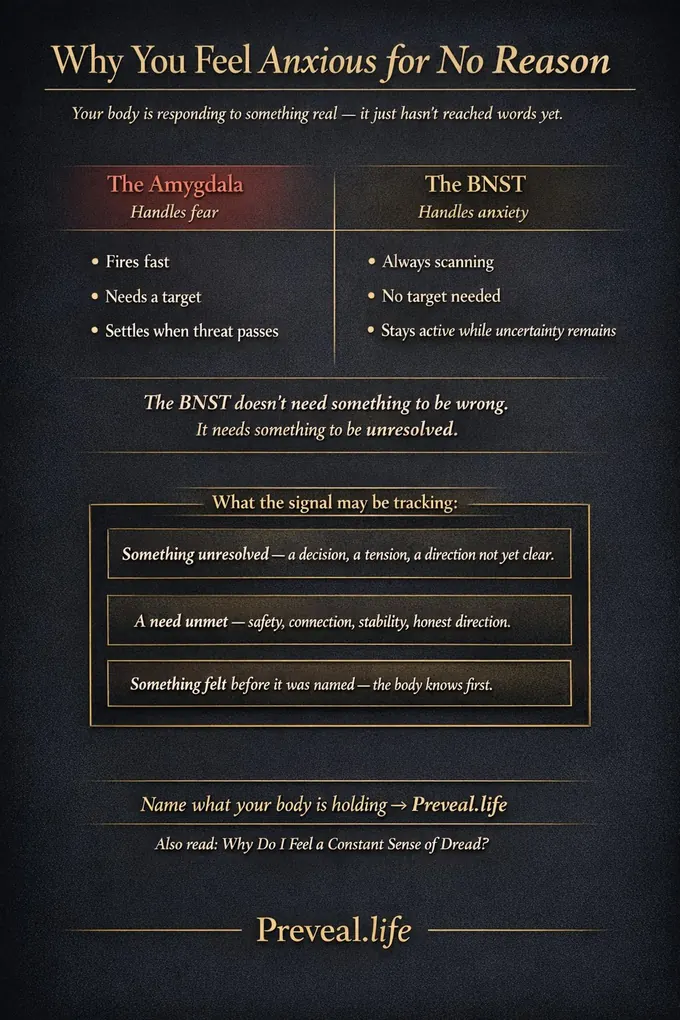
Why do I feel anxious for no reason? Sometimes the body reacts to pressure, uncertainty, emotional overload, or unresolved tension before the mind fully understands what is happening. The feeling may seem random, but the body is often noticing something before conscious awareness catches up.
Why Am I Anxious for No Reason?
If you are asking why am I anxious for no reason, the answer may begin in the body rather than in a thought. You may not have a clear worry. You may not be able to point to one obvious event. But your body may still be holding quiet pressure, uncertainty, or emotional overload from the background of your life. You do not need a perfect explanation before you care for yourself.
This kind of feeling can arrive while you are making breakfast, replying to a message, driving somewhere familiar, or lying in bed before the day starts. It can feel like being slightly braced for something, even when nothing is visibly wrong. You might reread the same message repeatedly, not because the words changed, but because your body still has not settled.
If you are struggling to name what your body is carrying, the Preveal reflection tool can help slow the signal down enough to notice it. Use the free Preveal reflection tool.
Pause and Notice
Before trying to solve the feeling, give your body a moment to be heard. This is not about forcing an answer. It is about creating enough steadiness for the signal to become clearer. The body sometimes notices what the mind has not caught up to yet.
- Where are you holding this feeling right now?
- What has quietly been building lately?
- What feels unresolved beneath the surface?
Try one small grounding action. Unclench your jaw. Let your shoulders drop. Take one slower exhale than usual. Then look around and name three ordinary things in the room. The aim is not to erase the feeling. The aim is to help your body feel a little less alone with it.
When Life Looks Normal but Your Body Feels Alert
The confusing part is that feeling on edge without knowing why often happens in ordinary moments. You might be sitting still, but your body feels ready. You might keep checking messages because some part of you feels like something is pending. You might feel stomach tightness while doing something simple, like folding laundry or waiting for a page to load. Sometimes your stomach sinks before opening an email, even before you know what you expect to find.
There may be no dramatic cause. There may only be a quiet pileup of small things: a decision delayed, a conversation avoided, a plan that no longer feels right, a need you keep pushing down, or a week of carrying more than you admitted. You may be carrying more than you realized.
The American Psychological Association describes stress as something that can show up through the body, including physical cues and tension that people may notice before they fully understand what they are carrying. [1] In this article, that idea stays in the wellness lane: your body may be offering information, not a label.
What Your Body May Be Carrying Quietly
Feeling unsettled without explanation can be your body staying braced around something unfinished. Maybe there is a message you do not want to open. Maybe you are waiting for someone to respond. Maybe you feel responsible for too much. Maybe your body has been absorbing emotional weight all week and only now has enough quiet to show it. You might feel relief when plans get cancelled, not because you wanted to disappoint anyone, but because your body finally gets a little room.
This is why the feeling can seem to come out of nowhere. It may not be new. It may simply be the first moment you have slowed down enough to notice it. The body often speaks quietly first.
Harvard Center on the Developing Child describes lifelong health as shaped by the interaction between experiences, relationships, and the body's ongoing response to life context. [2] For a wellness reader, the takeaway is simple: what happens around you can live in the body before it becomes a clear sentence in the mind.
What the Feeling May Be Asking For
The feeling may be asking for rest. It may be asking for clarity. It may be asking you to stop postponing something. It may be asking for reassurance, support, a boundary, a conversation, or a gentler pace.
Not every signal needs immediate fixing. Sometimes the next step is small: write down the concern, answer the message, step outside, drink water, ask for clarity, or admit that something has been quietly heavy.
Inside that small pause, the central idea matters again: your body can feel pressure before your mind has words for it. When you listen from there, the feeling becomes less like an enemy and more like an inner cue. Sometimes the body softens once it feels acknowledged.
If this does not fully match what you are feeling, use the closest pattern below:
How to Reflect Without Spiraling
Reflection works best when it is gentle. You are not interrogating yourself. You are noticing what your body may have been carrying in the background. Your body may be asking to be noticed, not fought.
- Body: Where is the feeling strongest?
- Pressure: What has been building quietly?
- Context: What part of life has felt unfinished, unclear, or too full?
- Support: What would help your body feel a little more steady right now?
These questions do not demand a perfect answer. They give the feeling somewhere to land. They help translate the body's alertness into something you can meet with care. Lying down tired but unable to soften is still information. It tells you something in the body may still be holding on.
Body Signal Reflection
When the body feels anxious and the mind has no ready explanation, it can help to hold three layers together: what your body is showing, what emotional tone may be underneath, and what life context may be connected.
What do you notice physically? A tight stomach, held breath, clenched jaw, restless hands, or shoulders sitting high.
What is the emotional weather underneath? Braced, hurried, lonely, overfull, uncertain, or tired.
What has been present lately? Unspoken needs, avoided tasks, emotional overload, unclear plans, or pressure you have been carrying quietly.
Sometimes the body responds not with a clear thought, but with a physical gesture you did not plan. If that experience feels familiar, read why you may feel like hugging yourself when nothing is going right.
How Preveal helps when anxiety has no clear reason
Preveal is a body signal reflection tool for the quiet space between body and explanation. It helps you start with what you feel physically, then notice what emotional tone and life context may be connected.
It does not label you. It does not tell you what your feeling must mean. It helps you reflect on what your body may be trying to tell you.
Preveal is private to this device, free to use, and built for personal reflection and body awareness.
Quiet support note: If the feeling feels heavy for a long time or hard to carry alone, it may be worth talking through with someone you trust, a counsellor, or a supportive practitioner.
About Preveal: Preveal is a free body signal reflection tool published by Carvey Innovations Limited. It helps people explore tension, unease, numbness, and emotional friction through private self reflection. Learn more on the What Is Preveal? page.