Anxiety, sleep, and memory: what research says, with a separate look at related-query data, and small next steps that help.
By Derrick CarveyBSc Sociology, University of the West IndiesFounder, Carvey Innovations LimitedPublished October 11, 2026Wellness reflection
Feeling it right now? Start here
Important: a sudden sense of impending doom can sometimes accompany a medical emergency, such as a heart attack or a serious allergic reaction (anaphylaxis).[8] If dread comes with chest pain, trouble breathing, fainting, or swelling of the face or throat, contact emergency services now.
If you want, try noticing your surroundings. The exercise is optional; continue with normal breathing or stop whenever you wish.
Interactive · about two minutes · selections stay in this page
The Two-Minute Settle
Participation is optional. Breathe normally if you prefer and stop if uncomfortable. Some people find this calming.
This page does not send or save checklist selections or exercise progress. It requests external fonts; following links opens other sites with their own privacy practices.
5
Name five things you can see.
Say them quietly or in your head. Small things count: a light, a corner, your own hand.
4
Notice four things you can feel.
Your feet on the floor, the weight of your arms, the fabric against your skin.
3
Listen for three sounds.
Near or far. A fan, traffic, your own breath.
2
Find two things you can smell.
If nothing stands out, notice the air itself.
1
Name one thing you can taste.
Or simply notice your mouth and jaw, and let them soften.
Now let the breath lead.
If comfortable, breathe in gently for about four seconds and out for about six. Follow your normal breathing instead if that feels better. Stop if uncomfortable.
Ready
Six optional breaths, about a minute.
Exercise finished. Notice what, if anything, feels different. You can stop here.
Standalone text instructions
Without using the buttons, notice five things you can see, four you can feel, three sounds, two smells, and one taste. Skip any sense that is unavailable or uncomfortable. Then, if comfortable, take up to six gentle breaths, about four seconds in and six seconds out, or simply breathe normally. Stop whenever you wish. No timer or interactive tool is needed.
A visual metaphor for worry, crowded attention, and recall at the edge of sleep. AI-generated editorial illustration.
Not Broken
Whatever brought you here, this forgetting is not the whole of you. What carries you toward clarity may be within you, around you, or found with the help of others. Noticing what is available to you right now is where this reflection begins.
Difficulty remembering does not define your worth, and this article cannot establish its cause. Anxiety and poor sleep may contribute, but memory changes can have other explanations. Outside support may help you understand what is happening.
We won't promise that reading this will lift the feeling. What this page can do is give you language for what is happening, the research behind it, and a few small tools, so you can decide what, if anything, comes next. If the honest next step is support, that was never evidence of a defect. It is information about what this moment asks.
It's late. You've read headline after headline, and something tight has settled in your chest. You may later find it hard to recall what you read.
We've watched this happen to people close to us. One friend spent her evenings on her phone, then started waking early with a fear she couldn't shake. Soon she was forgetting things she needed to remember. You'll meet her a little further down.
Difficulty remembering does not define your worth, and this article cannot establish its cause. Worry and disrupted sleep are possible contributors, alongside other explanations. The research and optional activities below may help you reflect on what is happening.
What the supplied Google Trends queries show
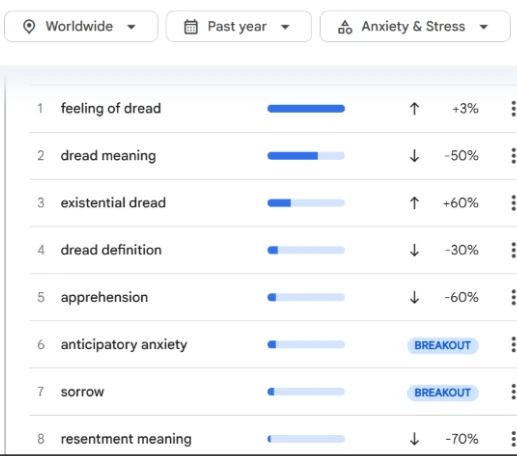
The two 14:46 exports contain the same eight related queries, scores, and growth values, in different orders. The table preserves those values. The supplier identifies these exports as Anxiety & Stress within Mental Health. The article originally identified the seed as "dread"; that setting cannot be independently confirmed from the supplied CSV contents or cropped screenshot.
Primary dataset: the supplied 14:46 Google Trends top and rising related-query CSV exports (eight matching rows). Normalized relative interest: the highest-ranked query in this dataset = 100; these are not absolute search counts. Changes are exported growth values. Breakout is a growth designation of more than 5,000%, not total searches.[9]
Search
Normalized interest
Exported change
feeling of dread
100
+3%
dread meaning
64
−50%
existential dread
29
+60%
dread definition
12
−30%
apprehension
10
−60%
anticipatory anxiety
10
Breakout
sorrow
7
Breakout
resentment meaning
3
−70%
Supplied screenshot: eight queries matching the 14:46 exports. Visible filters: Worldwide, Past year, Anxiety & Stress. Exact dates appear only in the CSV filenames (11 Oct 2025 to 11 Oct 2026); the seed query and search type are not visible. Data source: Google Trends. Tap to enlarge.
Reading the values
Relative ranking: "feeling of dread" has the highest normalized interest in this export, at 100. "Dread meaning" is 64 and "existential dread" is 29. A score of 100 does not mean 100 searches or 100% of people.
Exported growth: "feeling of dread" is +3% and "existential dread" is +60%. These are the exported changes; the precise comparison period is not recorded in the files.
Breakout: "anticipatory anxiety" and "sorrow" carry Google's designation for growth greater than 5,000%. A large increase can begin from a small baseline; the designation does not establish high absolute search volume.
A separate export: the 14:45 top and rising files contain only "dread meaning", with normalized interest 100 and change +60%. They are not merged with the 14:46 dataset. Their category is supplier-identified as Depression; full settings are not recorded. Scores are independently normalized, so the +60% and −50% figures should not be reconciled or compared as though they came from the same search configuration.
Search settings and verification limits
The screenshot shows Worldwide, Past year, and Anxiety & Stress. The filenames label Worldwide and a range from 11 Oct 2025 to 11 Oct 2026, with 14:46 or 14:45 time suffixes. CSV contents contain only query, search interest, and increase percent. They do not record the seed term or topic, category ID, search property (such as Web Search), exact filter configuration, comparison baseline, export timezone, or extraction method. The screenshot's match to the eight-row export is based on its query order and displayed growth values; the cropped image does not independently establish all original settings. The supplier identified the one-row 14:45 exports as Depression and the eight-row 14:46 exports as Anxiety & Stress, within the Mental Health category. The supplied screenshot independently shows Anxiety & Stress. The CSVs do not preserve the complete original search settings. No supplied reproducible URL confirms these settings.
What this evidence can tell us: these are normalized related-query data about search activity. They cannot establish how prevalent dread is, whether it is increasing, what an individual feels, why someone searched, or whether anyone has memory difficulties. The memory and sleep discussion below draws separately on peer-reviewed research about anxiety, attention, and memory consolidation.[2][3] Google Trends does not test those mechanisms.
What dread actually is
Dread is anticipation: your mind bracing for a threat that hasn't arrived and that it can't fully see. Fear reacts to a danger in front of you. Dread responds to a danger that might come. Psychologists describe this kind of forward-looking worry as anticipatory anxiety.
Psychologists Dan Grupe and Jack Nitschke describe how uncertainty about what might happen, when, and how bad it will be makes it harder to prepare, and that gap feeds anxiety. Their review argues that how people anticipate uncertain threats, more than how they react once something happens, sits at the heart of much anxiety.[1]
That's why dread so often attaches to the unknown: the news, money, health, the future. The less certain things feel, the harder your mind works to stay ready. This may be one way to understand worry; it does not establish the cause of memory changes.
Research explains patterns across thousands of people. Everyday experience shows how those patterns look up close. These are observations, not causes: a feeling and a situation can show up together without one explaining the other.
Joy's evenings
For a couple of weeks, Joy (not her real name) spent most evenings after work on her phone, mostly watching funny videos, nothing heavy, until bedtime. Then a dream started coming back night after night: a tense confrontation, with a fear that stayed with her all the way through it. She began waking early and staying awake. Soon she noticed she couldn't recall things when she needed them, and that worried her. The tiredness started to show.
Body Signal
Weariness, early waking
Emotional Tone
Fear that carries over from the dream into the morning
Life Context
Long evenings of scrolling, shorter nights
What struck us is that Joy wasn't scrolling bad news. This is evening scrolling, not evidence of doomscrolling. Phone use may displace sleep or wind-down time, but this account does not establish that it did so. We can't say what caused her dreams or her forgetfulness. We can say the pieces showed up together, and they're worth paying attention to.
Joy's story is still unfolding. Recurring nightmares and ongoing poor sleep are worth raising with a doctor, and both are often treatable.
Shared with permission. Name and details have been changed.
Research suggests two possible pathways: worry may compete with attention during learning, and disrupted sleep may affect memory consolidation. These findings do not explain every instance of forgetfulness or diagnose its cause.
By day: a crowded workspace
Working memory is the small mental desk where you hold what you're reading or doing right now. Attentional control theory, developed by psychologist Michael Eysenck and colleagues, proposes that anxiety pulls attention toward possible threats and weakens your ability to tune out distractions.[2] Worry may compete with the attention needed to learn. People can often still get the task done, but it costs more effort.
By night: interrupted filing
While you sleep, your brain replays and strengthens what you took in during the day. Researchers Susanne Diekelmann and Jan Born reviewed the evidence that sleep plays an active role in this consolidation.[3] If worry or evening scrolling disrupts sleep, memory processes may be affected. This does not establish the cause of any particular memory difficulty.
Anxiety and sleep disruption are possible contributors to difficulty remembering. They do not rule out other causes; seek professional advice when memory changes are new, worsening, persistent, or disruptive.
There's hopeful news here too. In one study, students who wrote about their thoughts and feelings on a stressful life change showed bigger gains in working memory seven weeks later than students who wrote about everyday topics. The researchers think writing eased the intrusive thoughts, freeing up mental space.[4] Brief journaling can be an optional reflection experiment. This study does not establish that a quick journal tool immediately improves memory.
The doomscroll loop
Doomscrolling describes continued consumption of negative online content. Dread, checking, and sleep disruption may form a reinforcing pattern for some people, but the direction of these relationships is not established.
In an American Academy of Sleep Medicine survey of 2,007 U.S. adults, 38% reported that bedtime doomscrolling worsened their sleep and 14% said they never did it.[7] These are self-reports, not measurements of memory impairment. A 2026 review of 17 studies found associations between doomscrolling and mental health difficulties and discussed rumination and platform design.[6] Most studies were cross-sectional; self-report bias and inconsistent definitions limit conclusions. Causal pathways remain unresolved.
Interactive · 30 seconds · selections stay in this page
What do you notice about your evenings?
Tick whatever feels familiar.
Which observations, if any, seem connected or worth exploring? You decide what they mean. This checklist has no score, thresholds, or validated interpretation.
Explore the habit: Why Do I Keep Doomscrolling?
For a closer look at the scrolling itself, read Why Do I Keep Doomscrolling? Meaning and Alternatives. The companion guide offers examples, reflection questions, and alternatives to consider. Use them to notice what happens before, during, and after scrolling, without treating an answer as proof of a cause.
Try separating three observations: Body Signal (such as tension you notice), Emotional Tone (perhaps dread or uncertainty), and Life Context (such as checking updates before bed). Scrolling is a behavior; it does not identify its own emotional meaning. Which connections, if any, fit is yours to decide.
Pick an optional step that seems useful. These are reflection experiments, not established treatments for everyday forgetfulness. Time needed varies; you can use a notebook and your own routine without an external tool.
Set a phone bedtimeConsider powering down electronics 30 to 60 minutes before bed, as advised by the American Academy of Sleep Medicine.[7] Notice whether this fits your circumstances.
Unload the dayOptionally write down what you noticed in your body, the emotional tone, the context, and what can wait. A short entry is not a proven immediate memory intervention.
Explore one worryPut a concern into your own words. Ask what, if anything, seems worth addressing. You decide whether a possible connection fits.
Ease into restTry a comfortable transition away from screens. Choose a duration that works for you; it need not improve sleep or recall to count as a useful observation.
Try this tomorrow morning
As an optional experiment, try recalling three things from yesterday: something you read, something someone said, and something you did. Check afterward if you wish. Retrieval practice improved retention of studied prose in the cited research.[5] That finding does not establish this routine as a remedy for everyday forgetfulness or a test of intact memory.
Notice whether this activity is useful to you; skip it if it adds pressure.
When to reach out for more support
Talk with a healthcare professional about memory difficulties that are new, worsening, persistent, or disruptive to daily life. Anxiety and sleep are possible contributors, but this article cannot rule out other causes.
Reaching out can be a way to explore what support may help. Consider talking with a doctor or mental health professional if dread:
lasts most days for several weeks,
makes it hard to work, study, sleep, or care for yourself,
comes with panic attacks, or
comes with thoughts of not wanting to be here.
If little feels available to you right now, the three-question Not Broken Reflection can help you notice what is within reach and what you may need from outside.
If you're in crisis or feel unable to stay safe, please reach out now:
Jamaica: the Ministry of Health & Wellness Mental Health and Suicide Prevention Helpline, 888-NEW-LIFE (888-639-5433), offers free, confidential support around the clock.[10] People aged 16 to 24 can also message SUPPORT to 876-838-4897 on WhatsApp or SMS for the U-Matter chatline.[11]
Elsewhere: contact your local emergency number, or find a helpline in your country at findahelpline.com.
Preveal's tools support reflection and general wellness. They don't diagnose, provide therapy, or replace professional care.
Common questions about dread and memory
What does a feeling of dread mean?
A feeling of dread is a heavy, uneasy sense that something bad may happen, often felt in the body first: a tight chest, a dropping stomach, a braced jaw. It doesn't have one fixed meaning. It may connect to something in your life, or simply to tiredness or stress. Our body signals and emotions guide explores how the two can appear together.
What is existential dread?
Existential dread is unease about the big picture: the future, meaning, mortality, or the state of the world, rather than one specific event. The separate Google Trends table describes related-query activity; it does not measure this emotional experience.
Can anxiety really make you forgetful?
Anxiety may make attention less efficient, which can affect learning and recall. Performance can remain intact with extra effort. This does not establish why a particular person is forgetting; seek professional advice for new, worsening, persistent, or disruptive memory changes.
Why does dread feel worse in the morning or late at night?
At these quieter times there are fewer distractions, so worries have more room. Being tired also makes it harder to step back from anxious thoughts. For more, read our reflection guides on dread at night and 2am waking and dread.
Is a feeling of impending doom ever an emergency?
Sometimes. It can come with panic attacks, but it can also accompany a heart attack or a serious allergic reaction (anaphylaxis).[8] If it comes with chest pain, trouble breathing, fainting, or swelling of the face or throat, seek emergency care right away. Our guide to the feeling of impending doom goes further.
Does doomscrolling affect sleep?
In the cited AASM survey, 38% of respondents reported worse sleep with bedtime doomscrolling. This is self-reported sleep impact, not evidence that scrolling caused memory impairment. Sleep supports memory consolidation, but individual causes require assessment.
References
[1]
Grupe, D. W., & Nitschke, J. B. (2013). Uncertainty and anticipation in anxiety: An integrated neurobiological and psychological perspective. Nature Reviews Neuroscience, 14(7), 488–501. doi.org/10.1038/nrn3524. A review of how uncertainty and anticipation shape anxiety.
[2]
Eysenck, M. W., Derakshan, N., Santos, R., & Calvo, M. G. (2007). Anxiety and cognitive performance: Attentional control theory. Emotion, 7(2), 336–353. doi.org/10.1037/1528-3542.7.2.336. The theory linking anxiety to reduced attentional control and working-memory efficiency.
[3]
Diekelmann, S., & Born, J. (2010). The memory function of sleep. Nature Reviews Neuroscience, 11(2), 114–126. doi.org/10.1038/nrn2762. A review of evidence that sleep actively consolidates memories.
[4]
Klein, K., & Boals, A. (2001). Expressive writing can increase working memory capacity. Journal of Experimental Psychology: General, 130(3), 520–533. doi.org/10.1037/0096-3445.130.3.520. Experiments with university students; a direction, not a guarantee for everyone.
[5]
Roediger, H. L., & Karpicke, J. D. (2006). Test-enhanced learning: Taking memory tests improves long-term retention. Psychological Science, 17(3), 249–255. doi.org/10.1111/j.1467-9280.2006.01693.x. Classic evidence for retrieval practice.
[6]
Sharpe, A., Tyndall, I., Poulus, D., Obine, E., & Sharpe, B. T. (2026). The influence of doomscrolling on mental health: A scoping review. Mental Health and Digital Technologies, 3(3), 290–342. doi.org/10.1108/MHDT-10-2025-0068. A review of 17 empirical studies; it maps the research rather than proving causes.
[7]
American Academy of Sleep Medicine (2026). Sleep Prioritization Survey, 2,007 U.S. adults, fieldwork June 5–13, 2025. Original survey results; official advice. Self-reported sleep impact; memory impairment was not measured.
Google Trends: supplied CSV exports and screenshot. Primary evidence: the 14:46 top and rising files, eight matching rows. The screenshot shows Worldwide, Past year, Anxiety & Stress. Filenames indicate 11 Oct 2025 to 11 Oct 2026; full original settings remain unverified. The supplier identifies the 14:45 one-row exports as Depression and the 14:46 eight-row exports as Anxiety & Stress, within Mental Health. The screenshot independently shows Anxiety & Stress. Scores are independently normalized; the exports remain separate. Google's related-search methodology. Normalized related-query scores and growth designations, not absolute volume or evidence of emotional prevalence.
[10]
Ministry of Health & Wellness, Jamaica. Mental Health and Suicide Prevention Helpline, 888-NEW-LIFE (888-639-5433). moh.gov.jm; hours and cost via findahelpline.com.
[11]
Ministry of Health & Wellness, Jamaica. U-Matter mental health chatline for ages 16 to 24. moh.gov.jm.
About the Author
Derrick Carvey is the founder of Carvey Innovations Limited and creator of Preveal, a non-diagnostic body-signal reflection framework for exploring emotional tone and life context through everyday physical signals.
Derrick holds a BSc in Sociology from the University of the West Indies. Preveal articles are written as wellness reflection resources, not medical or mental health diagnosis.
Try Preveal
Start with what you notice now: the Body Signal, the Emotional Tone around it, and the Life Context it sits in. Choose what, if anything, you want to explore.