
Report Summary
Executive Summary
- Anxiety disorders affect an estimated 4.4% of the global population.
- Research increasingly links anxiety with how people notice, evaluate, and interpret body signals.
- Interoception describes the nervous system's process of sensing internal body states such as heartbeat, breathing, gut sensations, tension, and discomfort.
- Alexithymia research suggests that 10–23% of adults may struggle to identify and describe emotions clearly.
- The evidence points toward a signal-recognition gap: people may feel something in the body before they can explain what it means.
Section 01
Key Takeaways
The central question this data addresses: why do so many people feel something in their body — a tight chest, a hollow stomach, a restless alertness — and still not know what it means? The research below suggests this is not a personal failing. It is a measurable gap between physiological signal and emotional recognition, and it appears to sit at the intersection of several of the most significant mental health trends of 2026.
Interoception is the nervous system's process of sensing and interpreting signals from inside the body — heartbeat, breathing, gut sensations, muscular tension, internal stress responses. It is not a wellness concept. It is a measurable neurological process, and research evidence increasingly suggests it is the mechanism through which that gap either opens or closes. When interoceptive processing is intact, body signals reach conscious awareness with enough clarity to act on. When it is disrupted — through anxiety, alexithymia, trauma, or simply a lack of body literacy — the signal arrives but the meaning does not. You can map your own physiological signals using the free, private Preveal body-signal reflection tool to begin bridging that gap.
The research landscape in 2026 points to a striking convergence. Anxiety disorders appear more prevalent than at any point in recorded epidemiological history. Interoceptive processing research is revealing why the felt experience of that anxiety so often resists language. And alexithymia data is quantifying how many people carry body signals they cannot decode. These are not separate findings. They are measurements of the same gap, taken from different angles.
The data below is drawn entirely from peer-reviewed journals and global health databases. Each section addresses a different dimension of the same gap — the space between what the body signals and what the mind can recognise and name. Anxiety prevalence data establishes the scale. Interoception research identifies the mechanism. Alexithymia statistics name the gap directly. Somatic signal data shows what the gap produces. And the intervention literature suggests the gap can be narrowed. Read as a collection, these numbers describe the same phenomenon from different methodological angles.
4.4%
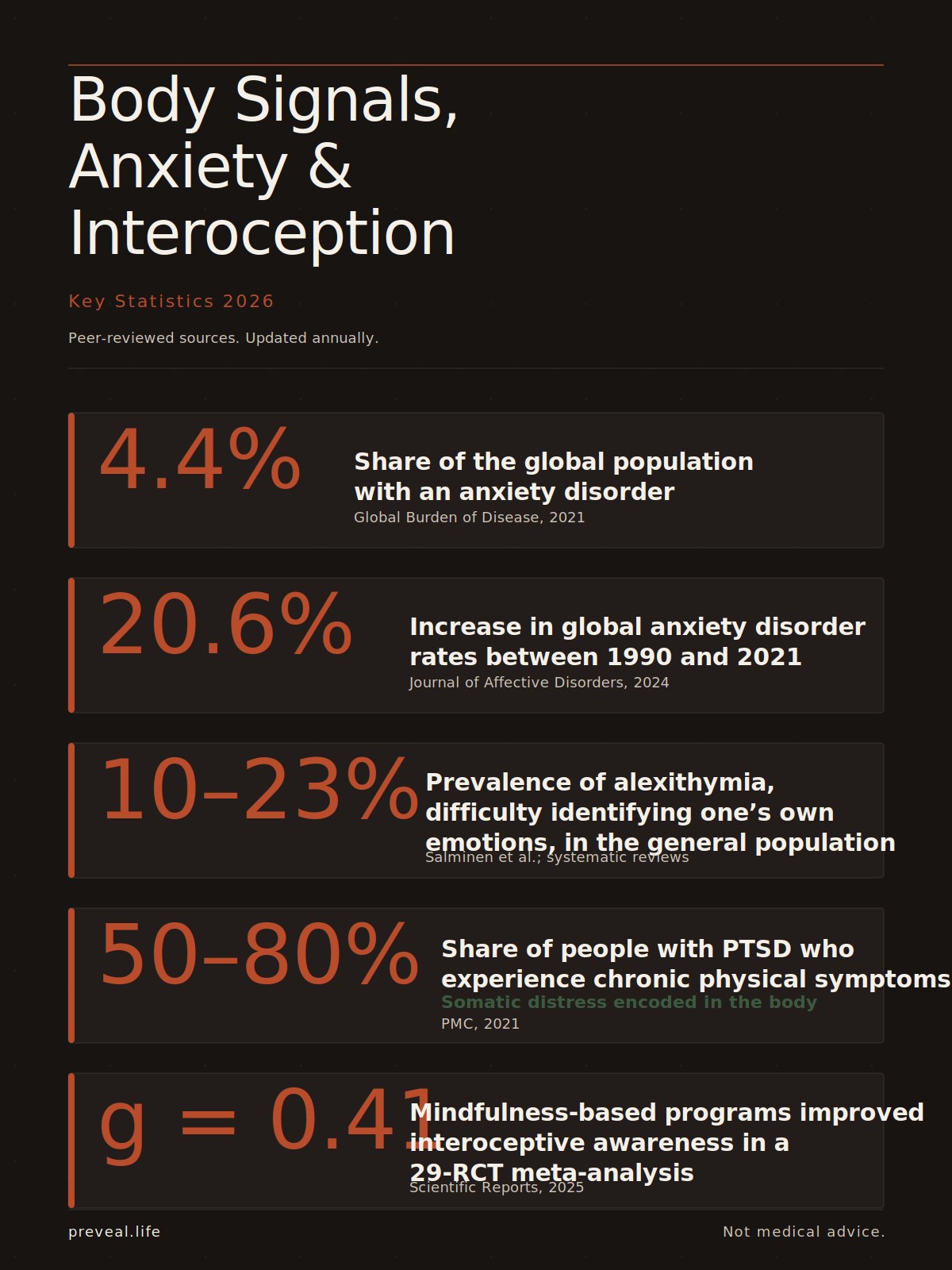
Estimated share of the global population meeting diagnostic criteria for an anxiety disorder, representing hundreds of millions of people worldwide. The prevalence has risen consistently since 1990.
20.6%
Increase in the global age-standardised rate of anxiety disorders between 1990 and 2021.
71
Studies included in a 2024 meta-analysis confirming that anxiety is associated with increased negative evaluation of and sensitivity to bodily signals.
10–23%
Estimated prevalence of alexithymia, the clinical difficulty identifying and describing one's own emotions, in the general population.
Section 02
Anxiety and Stress Statistics
Anxiety disorders represent the single most common category of mental health conditions globally. The data below reflects both the scale of the problem and the direction of its trajectory. The numbers do not flatten into abstraction once you understand what they describe: people experiencing sustained physiological activation, often without adequate language or framework to interpret what their bodies are signaling.
52%
Increase in the global incidence of anxiety disorders among people aged 10 to 24 years between 1990 and 2021, with the steepest acceleration occurring after 2019.
34%
Estimated lifetime prevalence of anxiety disorders in the general population, based on DSM-5 and ICD-11 diagnostic systems.
76.2M
Additional cases of anxiety disorders recorded globally in 2020 alone, attributable to the COVID-19 pandemic, bringing the total prevalence to 4,802 cases per 100,000 population.
43%
Share of U.S. adults reporting feeling more anxious in 2024 than they did the previous year, according to the American Psychiatric Association's annual mental health poll.
$1T
Annual cost to the global economy from stress, depression, and anxiety, expressed as approximately 12 billion lost workdays each year, according to the World Health Organization.
2×
Increased likelihood of developing metabolic syndrome among individuals experiencing prolonged high stress, including elevated blood pressure, blood sugar, and cardiovascular risk markers.
"Anxiety disorders are among the most prevalent mental health conditions globally, causing substantial psychological and social impairments. The data shows a consistent upward trend across age groups, regions, and income levels."
13.3%
Portugal recorded the highest national prevalence of anxiety disorders in 2023, at an estimated 13.3% of its population. Australia saw the largest relative increase of any country between 1990 and 2023, with prevalence rising by 178%, from 4.0% to 11.2%.
Source: Our World in Data / GBD 2023, via SingleCare Anxiety Statistics (2026)
What the global burden data consistently shows is that anxiety is not evenly distributed by geography alone. Women of childbearing age represent a particularly affected demographic. By 2021, the global prevalence of anxiety disorders among women of childbearing age had reached 138.3 million cases, a 77% increase since 1990. The incidence and disability-adjusted life years in that group rose by the same proportion over the same period.
138M
Women of childbearing age living with anxiety disorders globally as of 2021, reflecting a 77% increase in both prevalence and incidence since 1990.
Source: PMC Global Trends in Anxiety Disorders Among Women of Childbearing Age (2021 GBD Data)
Research Definition
What Is Interoception in Simple Terms?
Interoception is the nervous system's process of sensing signals from inside the body, such as heartbeat, breathing, gut sensations, muscle tension, temperature, and internal discomfort.
It helps connect physiological signals with conscious awareness. In the context of anxiety and emotional awareness, interoception matters because people may feel a body signal before they can clearly name the emotional or situational meaning attached to it.
Research Context
How Does Interoception Relate to Anxiety?
Interoception relates to anxiety because anxiety is often associated not only with noticing body signals, but with evaluating those signals as threatening, uncomfortable, or difficult to interpret.
The 2024 meta-analysis covering 71 studies should be read as evidence of association, not simple causation. Across the included studies, anxiety was linked with negative evaluation of body signals, increased attention to bodily sensations, difficulty describing those signals, and a gap between body awareness and body trust.
This distinction matters for interpretation. The research does not suggest that body awareness is inherently harmful. It suggests that body signals can become more distressing when they are noticed without enough trust, language, or emotional context to interpret them accurately.
Section 03
Interoception and Body Signal Statistics
Interoception refers to the nervous system's ongoing process of detecting and interpreting signals from within the body: heartbeat, breath rate, gut sensations, muscular tension, temperature, and dozens of other physiological states. It is not a wellness concept. It is a neuroscientific construct with a rapidly growing evidence base connecting it to anxiety, depression, trauma, eating disorders, substance use, and emotional regulation.
The data below reflects what peer-reviewed research in clinical psychology, neuroscience, and psychophysiology has established about the relationship between interoceptive processing and mental health outcomes.
g = 0.31
Small-to-medium positive effect size observed across 29 randomised controlled trials (2,191 participants) demonstrating that mindfulness interventions significantly improve self-reported interoceptive awareness.
g = 0.41
Effect size for mindfulness-based programs specifically, the highest of all intervention categories tested, confirming their particular value for interoceptive awareness improvement.
29 RCTs
Number of randomised controlled trials included in the 2025 meta-analysis of mindfulness training and interoception, with a combined sample of 2,191 participants, 77.8% female, mean age 32.8 years.
Research Analysis
A 2024 meta-analysis covering 71 studies examined how self-reported interoception relates to anxiety across 12 different measurement instruments. The consistent finding was that anxiety is associated with increased negative evaluation of bodily signals, greater attention to those signals (particularly negative attention), and measurable difficulty describing them. Anxiety was also linked to greater sensitivity to bodily signals overall.
What is notable is the directionality. The research does not describe people who are simply hypersensitive. It describes people who notice more, evaluate it more negatively, have more difficulty naming what they feel, and then struggle to use those signals meaningfully. This is a processing gap, not a sensory deficiency.
Source: Neuroscience and Biobehavioral Reviews, ScienceDirect (October 2024)
61.7%
Proportion of the total effect of interoceptive awareness on depression that was mediated through anxiety, in a 2024 study of 414 adults. The remaining 38.3% was a direct effect, suggesting interoception shapes mental health both through and independently of anxiety.
Source: Psychiatry International, Vivas-Rivas et al. (November 2024)
Research using computational models has begun to explain the underlying mechanism. People with generalised anxiety disorder show significantly higher heart-evoked potential amplitudes, a neural measure of interoceptive prediction error, even in response to neutral stimuli. This suggests that the anxious nervous system is not simply reacting to more signals; it is generating amplified discrepancies between what it expects and what it receives from the body, a pattern described in 2024 research published via PMC.
4
Psychiatric conditions where altered interoceptive processing has been confirmed by research evidence: depression, anxiety, eating disorders, and substance use disorders. Evidence of interoceptive dysfunction extends further into PTSD, panic disorder, and dissociative presentations.
Source: MedRxiv, Transdiagnostic Interoceptive Precision Study (2023); PMC Bayesian Computational Model (2020)
Section 04
The Missing Distinction: Body Awareness Is Not the Same as Body Trust
Most people assume that anxiety is about feeling too much. But research is pointing to something more specific: the problem may not be how loudly the body speaks. It may be that people do not feel safe enough to listen to what it is saying.
A 2026 study in Frontiers in Psychiatry followed 305 people and found that those with higher anxiety were not necessarily worse at detecting body signals. What they had instead was lower trust in their own body, more worry when uncomfortable sensations arose, and more difficulty making sense of what those sensations meant. Notably, performance on a standard heartbeat detection task showed no meaningful link to anxiety at all.
That is a significant finding. It suggests the issue is not raw sensing ability. It is what happens in the moment after something is felt.
Think about a tight chest before a difficult conversation, a drop in the stomach before a decision, a heaviness that arrives without an obvious cause. These are real physical events. But feeling them does not automatically tell a person what they mean. Without a sense of safety around those sensations, many people either push past them, spiral into worry about them, or go numb to them entirely. The signal arrives. The meaning stays out of reach.
305
Participants in the 2026 Frontiers in Psychiatry study examining the relationship between interoception, anxiety traits, bodily trust, and intolerance of uncertainty.
Source:
Frontiers in Psychiatry (2026)
The same study found that people who struggle to tolerate uncertainty in general also tend to distrust their own body more and feel more unsettled by uncomfortable physical sensations. For clinicians, this points toward interoceptive beliefs, not just interoceptive accuracy, as a meaningful target. For anyone else, it means something simpler: if uncertainty already feels threatening in daily life, the body's ambiguous signals are likely to feel threatening too.
Why This Matters
Two people can feel the same racing heart. One reads it as the body responding to pressure and moves through it. The other reads it as something wrong and begins to monitor, brace, or withdraw. Same signal. Completely different experience.
This is why awareness alone is not always enough. A person can be very tuned in to their body and still feel confused, alarmed, or overwhelmed by what they notice, if the interpretive layer is missing or shaped by past experiences of threat.
Researchers call this the gap between interoceptive accuracy and interoceptive beliefs. Most people would simply call it the difference between noticing something and knowing what to do with it. Both matter. And for a long time, only one of them was getting measured.
Interpretive Model
The Signal Recognition Gap
Body Signal → Interoception → Emotional Recognition → Meaning → Action
The signal recognition gap describes the space between a physiological body signal and the point at which a person can recognise what that signal may mean emotionally or contextually.
A person may feel a tight chest, stomach drop, jaw tension, restlessness, heaviness, or internal discomfort and still not know what those signals mean. The body event is real, but the interpretation may remain unclear.
Research across interoception, anxiety, alexithymia, and somatic symptoms points toward this same gap from different directions: a physiological signal can reach awareness before it becomes emotionally legible. Anxiety research often emphasises negative evaluation and heightened attention to body signals. Alexithymia research describes difficulty identifying and describing emotional states. Somatic symptom research shows how emotional distress can be experienced physically before it is clearly understood.
Preveal's Body-Signal Reflection Framework uses a related Body Signal → Emotional Tone → Life Context sequence as a reflective structure. In report terms, this framework sits inside the same research question: how people move from a felt body signal toward clearer emotional and situational meaning.
Section 05
Somatic Symptoms and Emotional Distress
Somatic symptoms are physical sensations and complaints, pain, fatigue, tightness, rapid heartbeat, digestive disturbance, dizziness, without a clear organic cause. The research literature makes an increasingly confident case that these symptoms are not imagination, malingering, or exaggeration. They are the body's method of encoding emotional and psychological states that have not yet found language.
10–23%
Prevalence of alexithymia, the measurable difficulty identifying and describing one's own emotional states, in the general population. Rates rise to 18% to 50% in psychiatric populations.
13%
Population-level prevalence of alexithymia in a representative Finnish national sample of 1,285 individuals, with rates of 17% among men and 10% among women.
50–80%
Share of people with PTSD who experience chronic physical symptoms, meaning long-lasting abnormal bodily sensations without sufficient organic explanation, as a co-occurring presentation.
12.7%
Pooled point prevalence of PTSD across people with chronic somatic diseases, drawn from 60 studies and over 21,000 participants in a 2023 systematic review and meta-analysis.
90%
Share of PTSD patients in a clinical sample who scored above the diagnostic threshold for alexithymia on the Toronto Alexithymia Scale-20, compared to general population rates of 10% to 14%.
41.2%
Prevalence of headache as a somatic symptom in a representative Danish population-based study, making it the most commonly reported physical symptom in that sample.
The data suggests that many people experience emotional distress through the body before they can clearly name it.
The relationship between alexithymia and somatic symptoms is not a simple correlation. A 2026 cross-sectional study of 523 psychosomatic outpatients found that alexithymia, specifically the difficulty identifying feelings dimension, serves as a mediating variable between negative life events and the severity of somatic symptoms. The body, in other words, is absorbing and expressing what the mind has not yet been able to process.
65.2%
Female share of a psychosomatic outpatient sample of 523 participants, mean age 41 years, in which alexithymia was shown to mediate the relationship between negative life events and somatic symptom severity.
Source: Frontiers in Psychiatry, Chen et al., Peking Union Medical College Hospital (January 2026)
Children are not exempt from this dynamic. A study examining schoolchildren following an earthquake found that somatic symptoms including trouble sleeping, low energy, stomach pain, dizziness, and headache were markedly more prevalent in children with probable PTSD than in controls. Trouble sleeping appeared in 83.2% of affected children. These were not adults with decades of conditioning. These were bodies communicating states that had not yet been given form in language.
83.2%
Prevalence of sleep disturbance as a somatic symptom in children and adolescents with probable PTSD following an earthquake, the most frequent somatic complaint in that group, followed by low energy at 74.4% and stomach pain at 63.2%.
Source: PMC, Somatic Symptoms and PTSD in Children Post-Earthquake
"Modern anxiety research increasingly suggests the body often reacts before conscious language catches up. The signals are there. The vocabulary is what is missing."
Data Visual
Five Statistics at a Glance
The infographic below distills the five most referenced statistics from this report into a single shareable asset. It is free to embed with attribution. The embed code is provided below the image.
Section 06
What These Numbers Mean
Taken together, this data sketches a picture that is consistent across geographies, age groups, and methodologies. Anxiety is rising. The mechanisms behind that rise are not fully understood, but interoceptive processing, specifically the capacity to notice, tolerate, and interpret internal body signals, appears to be a significant variable in who develops anxiety, how severely it presents, and whether it resolves or compounds over time.
Alexithymia, affecting roughly one in ten to one in five adults depending on the measurement standard, represents a specific vulnerability: people who feel their bodies reacting but cannot easily translate those reactions into emotionally legible experience. This gap is not a character flaw. The research frames it as a processing dimension, distributed across the population like other cognitive traits, not neatly separable from depression, anxiety, and trauma exposure.
Analyst Commentary
The 2024 Neuroscience and Biobehavioral Reviews meta-analysis covering 71 studies is particularly instructive. It found that anxious individuals are not simply more aware of their bodies in a generalised sense. They show increased negative evaluation of signals, greater difficulty describing those signals, and heightened attention that is specifically negatively valenced. The body is being heard but misread, or heard with too much alarm and too few interpretive tools.
This is why interventions that improve interoceptive processing, rather than simply reducing arousal, may represent a more durable pathway through anxiety. The 2025 meta-analysis in Scientific Reports found that mindfulness programs specifically produced an effect size of 0.41 on self-reported interoception, and that improvements in interoceptive awareness were correlated in size with improvements in psychological distress overall.
The implication is not that body awareness solves anxiety. It is that without some degree of interoceptive literacy, the body continues to signal and the person continues to lack the vocabulary to respond with any precision.
The PTSD data adds a further dimension. Between 50% and 80% of people with PTSD experience chronic somatic symptoms. The body is not merely stressed; it is encoding unprocessed experience in a form that resists conventional language-based approaches. Body-oriented therapy research, including the first randomised controlled trial of Somatic Experiencing, published in the Journal of Traumatic Stress, found effect sizes of Cohen's d between 0.94 and 1.26 for reductions in PTSD symptom severity, suggesting that direct engagement with bodily sensation may be among the more effective approaches to trauma resolution.
d = 0.94–1.26
Effect size range for reductions in PTSD symptom severity following 15 sessions of Somatic Experiencing therapy, in the first known randomised controlled trial of the approach, conducted with 63 participants meeting full DSM-IV-TR PTSD criteria.
Source: Journal of Traumatic Stress, Somatic Experiencing RCT (2017)
Section 07
Why Do Body Signals Matter in Emotional Awareness?
Body signals matter in emotional awareness because physical sensations often appear before people have clear language for the feeling, pressure, or context underneath them.
The body signals before the mind has caught up. This reflects the temporal structure of physiological arousal, where heart rate, muscle tension, gut motility, and skin conductance can respond to perceived threat, pressure, or relational challenge before conscious narrative has formed. Interoception is the bridge between that pre-verbal physiological state and the point at which a person can name what they are experiencing and choose how to respond.
When that bridge is functioning poorly, whether due to alexithymia, chronic dissociation, trauma, or simply a cultural and educational context that never trained body literacy, people are left with signals and no map. They feel something. They do not know what it means. They may catastrophise it, suppress it, somatise it, or seek external frameworks to explain an internal state that has not been given a name.
Body signals can operate as early cues in emotional recognition and life context. Ignoring them can delay clarity, while overinterpreting them can increase distress. The evidence therefore supports a careful middle position: body signals are meaningful data, but they require context, caution, and interpretation rather than automatic conclusions.
The research is consistent in suggesting that interoceptive training, whether through formal mindfulness-based programs, body-oriented therapy, or reflective somatic practices, can measurably improve a person's capacity to attend to, tolerate, and interpret internal signals. This is not a diagnostic or treatment claim. It is a research observation about the relationship between interoceptive awareness and psychological distress.
Context
Preveal was built around this gap: the space between feeling something in the body and having language for what it may mean. It is not a diagnostic tool. It does not label or classify. It offers a reflective space for people to notice what their body is communicating and to begin forming a relationship with those signals, on their own terms, at their own pace.
The statistics on this page describe the scale and cost of what happens when that capacity is absent or underdeveloped. They also suggest, particularly in the intervention literature, that the capacity can be developed, and that doing so has measurable effects on mental health outcomes.
About Preveal
A tool built for the gap between feeling and naming.
Preveal is a free, non-diagnostic body signal reflection tool grounded in the same research landscape this report draws from. It is not therapy and does not replace clinical care. It offers a structured, private space to notice, describe, and gently explore what your body may be communicating.
The founding principle: "Not broken. Becoming whole." The research above describes why that framing matters.
Explore Preveal →Further Reading on Preveal
Related Articles
The statistics in this report are directly relevant to the body signal patterns explored across Preveal's article library. The pages below draw on the same research territory and may help contextualise the data above.
- sense of impending doom body signal statistics — somatic anxiety responses
- feeling of dread anxiety and interoception research — pre-verbal threat signals
- body signals and emotions what the data says about anxiety and body awareness
- Body-Signal Reflection Framework research on emotional body signals — alexithymia and dissociation
- Why Do I Feel Like Hugging Myself When Nothing Is Going Right? body signal statistics — self-soothing and interoception
- Why You Feel Off But Cannot Explain It research on emotional body signals — somatic awareness
Research FAQ
Frequently Asked Questions
What is interoception?
Interoception is the nervous system's process of sensing signals from inside the body, including heartbeat, breathing, gut sensations, muscle tension, temperature, and discomfort. In research, it helps explain how physiological states become conscious body awareness and how those signals may connect to emotion, stress, and self-understanding.
How is interoception connected to anxiety?
Interoception is connected to anxiety because anxiety is associated with how people notice, evaluate, and interpret body signals. A 2024 meta-analysis found links between anxiety and negative evaluation of bodily sensations, increased attention to those sensations, and difficulty describing them. The evidence supports association, not a simple one-way cause.
Can body signals appear before emotions are understood?
Yes. Body signals such as chest tightness, stomach drop, jaw tension, restlessness, or heaviness can appear before a person has clear language for the emotion or context underneath them. Research on interoception, alexithymia, and somatic symptoms supports the idea that physiological signals can precede emotional recognition.
What is alexithymia?
Alexithymia is the measurable difficulty identifying, describing, and distinguishing one's own emotional states. Population studies suggest that roughly 10-23% of adults may experience alexithymia, depending on the sample and measurement method. It is often discussed in research on emotional awareness, somatic symptoms, anxiety, depression, and trauma-related presentations.
Why can emotional distress show up physically?
Emotional distress can show up physically because the nervous system, endocrine system, muscles, gut, breathing, and cardiovascular activity all participate in stress responses. When emotional meaning is unclear or difficult to verbalise, physical sensations may become the most noticeable part of the experience. This does not mean the symptoms are imagined.
What is the signal recognition gap?
The signal recognition gap is the space between feeling a body signal and understanding what it may mean. A person may notice discomfort, tension, restlessness, or heaviness before they can connect it to an emotion, pressure, memory, relationship, or life context. It is an interpretive gap, not a diagnosis.
How This Fits Within the Preveal Framework
Population research can describe recurring patterns in interoception, anxiety, alexithymia, and emotional awareness. The Preveal Framework organizes an individual's own observations without turning those population patterns into a personal conclusion:
Body Signal → Emotional Tone → Life Context → Personal Meaning → Immediate Need → Supportive Bridge → Thoughtful Next Action
The sequence begins with what is noticed, places it beside the feeling atmosphere and surrounding circumstances, and leaves Personal Meaning provisional and person-led. It may then help someone consider what is needed now, an appropriate supportive bridge, and a thoughtful next direction. It does not diagnose, predict, establish cause, or guarantee what any signal means.
Research can help answer, “What are we seeing across groups?” The Preveal Reflection Tool simply helps a person organize observations from their own experience using the Framework. It does not provide answers, confirm that an interpretation is correct, or create certainty.
Continue Exploring This Topic
For the wider research context, see The State of Body Awareness and Emotional Wellbeing. For a closer account of how sensations, emotional tone, and context can relate without fixed meanings, continue to the Body Signal Interpretation Report.
The Preveal Body Signal Framework sets out the complete Version 2 methodology. The articles What Is Interoception? and Why the Body Often Speaks Before the Mind Understands provide plain-language companion reading. What Is Preveal? explains the project's boundaries and purpose.
Methodology
This report was originally compiled in May 2026 and last reviewed in June 2026, using peer-reviewed sources drawn from PubMed, PubMed Central, ScienceDirect, Frontiers in Psychiatry, Nature Scientific Reports, JMIR Public Health and Surveillance, and the Global Burden of Disease 2021 and 2023 datasets. All statistics cited include direct links to the original source material.
Only peer-reviewed studies, meta-analyses, systematic reviews, and WHO or GBD database reports were included. Non-peer-reviewed sources, press releases, and commercial surveys were excluded except where they directly cite peer-reviewed backing, and those were cross-referenced accordingly.
This page will be reviewed and updated annually. If a cited source has been retracted, corrected, or superseded by stronger evidence, it will be updated or removed. Readers wishing to report a citation error may contact Carvey Innovations Limited via preveal.life.
Statistics on interoception should be interpreted with the understanding that the field uses multiple different measurement instruments, including the Multidimensional Assessment of Interoceptive Awareness (MAIA), the Toronto Alexithymia Scale (TAS-20), and heartbeat perception tasks. Results across studies are not always directly comparable. Meta-analytic findings, which aggregate across instruments, are therefore given priority where available.
Support Free Research
Everything published on Preveal is freely available.
Preveal was created to help people better understand body signals, emotional experiences, and life context through careful observation rather than rushed conclusions.
These reports remain free because the goal is to make reliable, research-informed information accessible to anyone who may benefit from it.
If this report helped you better understand a topic, supported your own research, or provided a useful perspective, you are welcome to support the continued development of Preveal.
Your support helps fund:
- independent research
- evidence reviews
- writing and editing
- website hosting
- development of new reports
- improvements to the free Preveal Reflection Tool
Whether you choose to support financially or simply share Preveal with someone who may benefit, thank you for helping keep this work freely available for everyone.
Sources
- Global Burden of Disease Collaborative Network. "Trends in the Epidemiology of Anxiety Disorders from 1990 to 2021." Journal of Affective Disorders, ScienceDirect (2024). sciencedirect.com
- Bie et al. "Rising Global Burden of Anxiety Disorders Among Adolescents and Young Adults: Trends, Risk Factors, and the Impact of Sociodemographic Disparities and COVID-19 from 1990 to 2021." Frontiers in Psychiatry (2024). pmc.ncbi.nlm.nih.gov
- Cao H. et al. "Global Trends in the Incidence of Anxiety Disorders From 1990 to 2019." JMIR Public Health and Surveillance (2024). publichealth.jmir.org
- COVID-19 Mental Disorders Collaborators. Global prevalence data on COVID-19 anxiety impact cited in Journal of Affective Disorders (2024). sciencedirect.com
- PMC / GBD 2021 Data. "Global Trends in the Epidemiologic Burden of Anxiety Disorders Among Women of Childbearing Age (1990–2021)." pmc.ncbi.nlm.nih.gov
- Our World in Data / GBD 2023 Study. Share of population with anxiety disorders. ourworldindata.org
- American Psychiatric Association. Annual Mental Health Poll (2024), cited in SingleCare Anxiety Statistics. singlecare.com
- WHO / Journal of Affective Disorders. "Global Evidence on the Prevalence of and Risk Factors Associated with Stress." (2025). sciencedirect.com
- American Institute of Stress / JAMA Psychiatry (2022). Stress and metabolic syndrome risk, cited in AIS report. stress.org
- Norris et al. "The Relationship Between Self-Reported Interoception and Anxiety: A Systematic Review and Meta-Analysis." Neuroscience and Biobehavioral Reviews, ScienceDirect (October 2024). sciencedirect.com
- Verdonk et al. cited in "Interpreting Anxiety Disorders from the Perspective of Interoceptive Computational Models." PMC (2024). pmc.ncbi.nlm.nih.gov
- Vivas-Rivas et al. "Does Interoceptive Awareness Influence Depression Through Anxiety in Peruvian Adults? A Mediation Analysis." Psychiatry International (November 2024). mdpi.com
- Transdiagnostic Interoceptive Precision Study. MedRxiv preprint (2023). medrxiv.org
- Bayesian Computational Model, Interoceptive Failure Across Psychiatric Disorders. MedRxiv (2020). medrxiv.org
- Bornemann et al. Meta-analysis of mindfulness training effects on interoception. Scientific Reports / Nature (December 2025). nature.com
- Lima-Araujo et al. "Minding the Body: A Meta-analysis of the Effects of Mindfulness Meditation Training on Self-reported Interoception." PMC (2025). pmc.ncbi.nlm.nih.gov
- Lima-Araujo et al. "The Impact of a Brief Mindfulness Training on Interoception: A Randomized Controlled Trial." PLOS ONE (2022). pmc.ncbi.nlm.nih.gov
- Salminen et al. "Prevalence of Alexithymia and Its Association with Sociodemographic Variables in the General Population of Finland." Journal of Psychosomatic Research (1999). pubmed.ncbi.nlm.nih.gov
- Springer Nature Link. "Prevalence of Alexithymia and Internet Addiction Among Students." Current Addiction Reports (2025). link.springer.com
- Hernandez et al. "Prevalence of Alexithymia in Patients with PTSD: A Cross-Sectional Study in Mexican Outpatients." Journal of Global Health Neurology and Psychiatry (2025). joghnp.scholasticahq.com
- Kang et al. "Associations Between Emotional Awareness Deficits and Somatic Symptoms in a Community and Clinical Population." BMC Psychology (July 2025). pmc.ncbi.nlm.nih.gov
- Chen et al. "Alexithymia Mediates the Pathway from Negative Life Events to Somatic Symptoms." Frontiers in Psychiatry (January 2026). pmc.ncbi.nlm.nih.gov
- Lunkenheimer et al. "Prevalence and Incidence of PTSD and Symptoms in People with Chronic Somatic Diseases: A Systematic Review and Meta-Analysis." Frontiers in Psychiatry (2023). pmc.ncbi.nlm.nih.gov
- Buhmann et al. "High Prevalence of Somatisation in ICD-11 Complex PTSD." PMC (2021). pmc.ncbi.nlm.nih.gov
- Testimonies from PMC, Somatic Symptoms and PTSD in Children Post-Earthquake. pmc.ncbi.nlm.nih.gov
- Rosenberg et al. "Somatic Experiencing for PTSD: A Randomized Controlled Outcome Study." Journal of Traumatic Stress, PMC (2017). pmc.ncbi.nlm.nih.gov
- Somatic Symptoms Prevalence, Danish Population-Based Study. PMC. pmc.ncbi.nlm.nih.gov
- SingleCare Stress Statistics (2026), drawing on APA, NIMH, and WHO data. singlecare.com